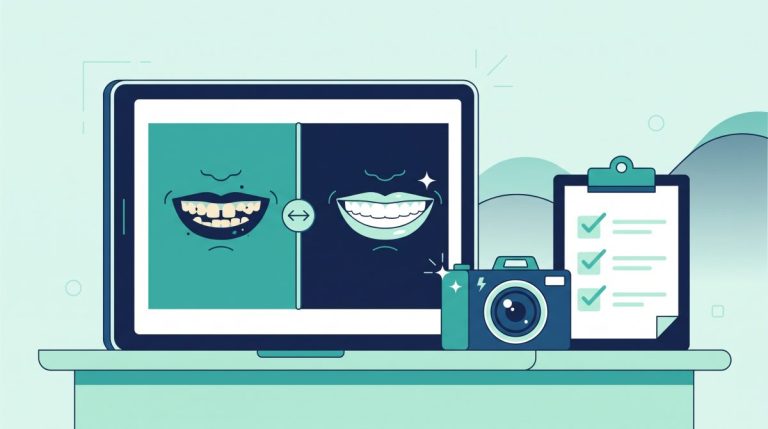
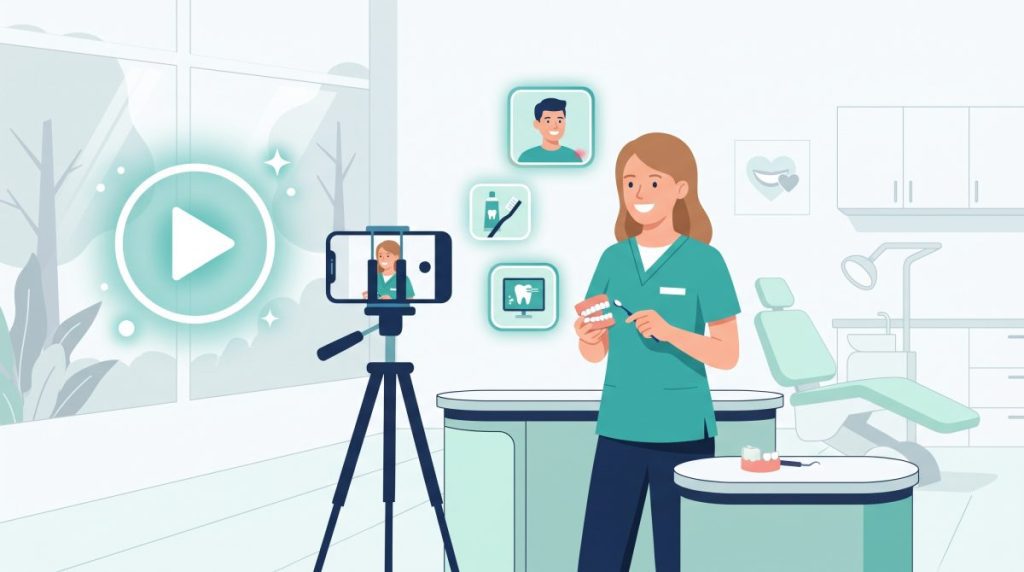
A dentist’s face and a patient’s before-and-after do two things text cannot: they build trust before the first appointment, and they answer the anxious question — what is this actually going to be like? That is exactly why video is one of the most under-used channels in dental marketing, and one of the most useful when done right.
Search demand for dental video has been building. Over the last twelve months, video-related searches have been climbing alongside the broader “dental marketing” interest cluster, and video is increasingly the format people meet a practice in — on the website, in social feeds, on YouTube, and increasingly inside AI answer engines that surface a practice’s own media when someone asks a question. For platform-specific tactics, see our guide to Instagram Reels for dentists.
This guide covers what video to make, where to put it, how it helps you get found, and where practices waste effort.
Why video works for dental practices
Dental care is a high-anxiety, high-uncertainty purchase. A person choosing an orthodontist, an implant surgeon or even a cleaning is making a decision under stress with very little information. Video reduces that uncertainty faster than anything else a practice can publish.
Concretely, video tends to help in three places:
On the website, where a nervous patient is deciding. A short practice-introduction video on the homepage or team page answers the unspoken questions — who are these people, are they friendly, does this feel like a place I’d want to walk into — before the patient ever clicks “book.”
In search and AI answers, where people research first. Most dental decisions start as a question typed into a search bar. Video on your own site gives you something to be found and shown for, and structured, captioned video is more usable to search systems than a bare link.
On social, where reach is essentially rented. Short video is the format social platforms currently distribute most. It is the cheapest way for a small practice to reach people outside its existing patient base.
The video types worth making
Team and practice introduction
Two to four minutes: who the practice is, what the philosophy is, what a visit feels like. This is the single highest-value video most practices never make. It belongs on the homepage or team page. Patients are deciding whether they trust you; showing them is faster than describing it.
Procedure and technique walkthroughs
Showing how a procedure is actually done — an animation, a short narrated clip, a step-through — addresses the two biggest barriers: fear of pain and fear of the unknown. Keep these educational and general, not individualized patient footage.
Before-and-after
The format patients look for most and practices are most cautious about. There are real rules here, and they are not stylistic preferences.
Patient consent must be explicit and specific, typically a written release that covers exactly what may be shown. Photographic or clinical identity must be de-identified or protected — the patient’s face, name, and any identifying detail should not appear unless there is specific documented consent for that exact use. In many cases, showing an anonymized result (teeth only, no face, no metadata, no captions naming the patient) is the safe approach. Align with your own compliance lead or attorney on what your practice’s standard is, and be conservative.
Technology and equipment explainers
“Here’s what our 3D scanner does and why it removes the gagging impression” is genuinely useful and low-risk. It answers real anxieties about modern dental care and showcases investment in the practice.
Patient testimonials
Respectful, brief, real. A patient describing a good experience is powerful. Scripted or fabricated testimonials are not — they are misleading to patients, and Google’s structured data guidelines specifically call out fake reviews as content that must not be marked up, and direct publishers not to use structured data to deceive or mislead users. Never manufacture a quote; never stage one.
Educational shorts
Short answers to the questions your front desk hears daily — why gums bleed, what a crown actually involves, whether whitening hurts. These are shareable, they fill social feeds, and they answer real patient questions. They also map naturally onto the “people also ask” style of questions that shape how dental content gets consumed by both search engines and AI assistants.
Where to publish it
On your own website
Host it yourself, not only on a third-party platform. Embedded YouTube is acceptable, but self-hosted gives you control over speed and context. Load matters — a video that tanks your page speed on mobile costs you more than the video earns. Keep a poster image and make it lazy-loaded.
Add accurate captions or a transcript. Captions make it usable for the many patients watching without sound, and they make the content legible to search and AI systems. Use descriptive titles and descriptions.
YouTube
YouTube is still the largest searchable video surface and increasingly surfaces inside AI answers. Create a simple, consistent channel — practice intro, procedure explainers, patient education. Titles should match how patients actually talk, not marketing-speak.
Google Business Profile video
Your Business Profile supports photos and video that appear directly on your listing and on Search, where local-search patients find you first — Google documents the upload and display flow in its Business Profile help. It is one of the least-used, highest-visibility placements available to a practice. Keep it short, professional, and current. Our article on Google Maps SEO for dentists covers the wider local-visibility picture.
Instagram and TikTok
Repurpose, don’t manufacture. Shoot once, cut the 60–90 second explainer and two or three short vertical clips from the same session. This is how a small practice stays consistent without a production budget.
Video and being found by AI answer engines
This is the newest reason to care about video. AI assistants increasingly answer a patient’s dental question directly — “how long does a root canal take,” “is Invisalign painful” — and when they do, they often draw on a practice’s own published explanations and video, not a directory listing.
Google’s guidance on AI search is clear that useful original content and normal SEO fundamentals remain the foundation, and specifically warns against producing pages for every query variation or expecting any special file to guarantee an AI citation. So the honest version of this is not “optimize for the robots” — it is “publish clear, well-structured answers to the questions patients ask, and video is a natural format for some of them.” See Google’s AI optimization guide.
Practically: answer real questions in your own words, keep the information accurate and current, describe your media accurately with captions and surrounding text, and do not fabricate structured claims.
Common mistakes
Producing a lot and publishing nothing. More is not the goal. Two good videos that answer the questions your front desk hears daily beat twenty that get ignored.
Ignoring mobile. Most patients will watch on a phone on mobile data. Shoot and export for that.
Waiting for perfect. A clear, honest phone-shot of the doctor explaining the practice is more useful and more human than a polished corporate video that looks like an ad.
Ignoring the compliance side. Consent for any patient appearance, de-identification of results, no clinical detail that identifies anyone, and no fabricated testimonials. When in doubt, involve your compliance lead or attorney.
Treating video as a substitute for basics. Video works alongside a fast, trustworthy website, current reviews, and clean local search — not instead of them. If your site is slow or hard to navigate, fixing that comes first; see why a dental website might be driving patients away.
Where video fits in a marketing mix
Video is the trust and reach layer. It works best alongside the channels that capture demand — local SEO, Google Ads and PPC — and alongside the reputation layer that turns satisfied patients into public proof. Our social media marketing page covers the wider organic-social picture, and dental marketing ties the whole program together.
If you want to know which three or four videos would matter most for your practice before you commit to a production budget, tell us what you’re trying to fix and we’ll be specific about the priority order.
Ready to grow your practice?
Book a Free Strategy Call