
Why Dental PPC Is a High-Stakes Game Worth Playing Right
Paid search advertising for dental practices is one of the fastest ways to fill your appointment book with high-intent patients ready to book. Unlike organic SEO, which takes months to build momentum, a well-managed Google Ads campaign can put your practice in front of patients the moment they start searching.
But here’s the catch: dental PPC is also one of the most competitive and expensive advertising categories online. Dental practices across the country are bidding on the same keywords, and without proper optimization, your budget can evaporate with very little to show for it.
This guide covers how to build, manage, and optimize a dental PPC campaign that actually delivers new patients — not just clicks.
1. Google Ads Account Structure: The Foundation of Success
Most failed dental PPC campaigns fail before they start — because the account structure is wrong. A well-organized account is essential for delivering relevant ads, controlling costs, and measuring results accurately.
Campaign Type: Search vs. Display vs. Performance Max
For most dental practices, Google Search campaigns are the primary driver of new patients. These text ads appear at the top of search results when someone types a relevant query like “dentist in [city]” or “emergency dentist near me.” Display campaigns can build brand awareness but typically drive lower-intent traffic. Performance Max is Google’s newest automated format — useful for some practices but requires strong conversion data to work well.
Start with tightly structured Search campaigns. Expand to other formats only once you have solid conversion data.
Organize Campaigns by Service Line or Geography
Don’t lump all your dental services into one campaign. Separate them by service category to enable more precise keyword targeting, ad copy, and landing pages:
- Campaign 1: General dentistry (new patients, checkups, cleanings)
- Campaign 2: Cosmetic dentistry (veneers, whitening, smile makeovers)
- Campaign 3: Emergency dental care
- Campaign 4: Specific procedures (implants, root canals, orthodontics)
If you serve multiple geographic areas, consider separate campaigns for each area with location-specific ad groups.
Ad Groups Within Campaigns
Within each campaign, create tightly themed ad groups. Each ad group should contain a small set of highly related keywords with tightly matching ad copy. Example ad group for cosmetic dentistry: [cosmetic dentist], [teeth whitening], [veneers dentist], [smile makeover].
2. Quality Score Optimization: The Hidden Lever That Controls Your Costs
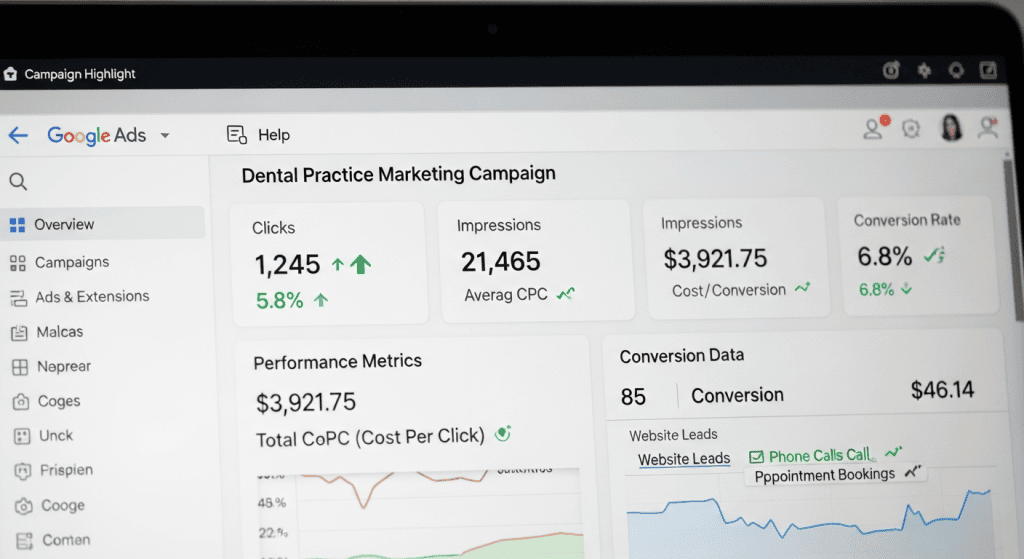
Quality Score is Google’s rating of the quality and relevance of your keywords, ads, and landing pages. It ranges from 1 to 10 and directly impacts your cost-per-click (CPC) and ad positions.
A higher Quality Score means you pay less for each click and get better ad positions. This is the most underutilized lever in dental PPC.
What Quality Score Is Based On
- Expected clickthrough rate (CTR): How likely are people to click your ad when it’s shown?
- Ad relevance: How closely does your ad match what the searcher is looking for?
- Landing page experience: How relevant and useful is the page users land on after clicking?
How to Improve Quality Score
The fastest path to higher Quality Scores is to create tightly themed ad groups with highly relevant keywords, write ads that directly address the searcher’s intent, and ensure your landing pages deliver exactly what the ad promises. If your ad says “Emergency Dentist — Same Day Appointments,” the landing page must immediately feature emergency dental services prominently.
3. Ad Extensions for Dentists: More Real Estate, More Trust
Ad extensions expand your ad with additional information — giving you more space in the search results and more reasons for patients to click. For dental practices, these extensions are particularly valuable:
Location Extension
Pulls in your Google Business Profile address and phone number. Shows a map alongside your ad. Essential for any practice with a physical location.
Call Extension
Adds a click-to-call button directly in your ad. Mobile searchers can call your office with one tap. For emergency dental services, this is especially powerful.
Callout Extensions
Short descriptive text highlighting what makes your practice unique: “Same-Day Appointments,” “New Patients Welcome,” “Insurance Accepted,” “Award-Winning Practice,” “Board Certified.”
Structured Snippets
Display lists of your service categories: “Implants, Veneers, Teeth Whitening, Orthodontics, Emergency Care.”
Review Extension
If you have enough reviews on Google (100+ with 4+ stars recommended), review extensions can display your star rating directly in the ad — powerful social proof.
Lead Form Extension
Allows searchers to submit an appointment request or inquiry directly from the ad without visiting your website. Particularly useful for high-intent queries like “dentist accepting new patients.”
4. Landing Page Best Practices: Don’t Waste Clicks on Bad Pages
Your landing page is where conversions happen — or don’t. Even the best-targeted ads and highest Quality Scores are wasted if your landing page doesn’t turn clicks into appointments.
Page Load Speed Is Non-Negotiable
If your landing page takes more than 3 seconds to load, you’re losing the majority of mobile visitors. Use Google’s PageSpeed Insights tool to audit your landing pages. Optimize images, enable browser caching, and use a reliable hosting provider.
Match Ad Copy to Landing Page Content
This is fundamental but widely ignored. If your ad is targeting “affordable dental implants,” the landing page must prominently address dental implant pricing, financing options, and before-and-after cases. Any disconnect between ad promise and landing page content kills conversions and hurts Quality Score.
Make the Primary Action Obvious
Every landing page should have one primary conversion goal. Make it impossible to miss: a prominent “Book an Appointment” button, a click-to-call phone number, or a simple contact form. Remove navigation menus that distract from the primary action.
Build Trust Immediately
Healthcare decisions are trust decisions. Above the fold, include: your practice name and logo, star ratings and review count, accreditations (ADA, BBB), and a clear phone number. New patients need to trust you before they’ll book.
Mobile-First Design
More than 60% of dental searches happen on mobile devices. Your landing pages must be optimized for mobile — large tap targets, readable text without zooming, fast load times, and prominent call buttons.
5. Budget Allocation: Where to Put Your Money for Maximum ROI
Dental PPC budgets vary enormously based on market size, competition, and practice goals. But how you allocate within your account matters just as much as how much you spend.
Prioritize High-Intent Service Keywords
General keywords like “dentist” are expensive and competitive. More specific, high-intent keywords often deliver better ROI: “dental implants [city],” “emergency dentist open Saturday,” “adult braces [city], “sedation dentist near me.” These queries indicate the patient is further along in their decision-making process and more likely to convert.
Allocate Based on Profit Margins by Service
If dental implants generate significantly more revenue per patient than routine cleanings, it makes sense to allocate a larger share of your budget to implant-related campaigns — even if the cost-per-lead is higher, the lifetime value justifies it.
Drip Feed vs. Accelerated Budget Spending
For most practices, it’s better to spread your daily budget evenly throughout the day rather than exhausting it early. Accelerating spending means your ads stop showing in the afternoon and evening — exactly when many people are searching after work.
Set Negative Keywords to Eliminate Waste
Regularly review search terms reports and add negative keywords to prevent your ads from showing for irrelevant queries. Common negative keywords for dental PPC: “jobs,” “salary,” “education,” “free,” “logo,” “clip art.” This prevents wasted clicks from people who aren’t looking for a dentist.
6. Common Dental PPC Mistakes That Drain Your Budget
These are the most costly errors dental practices make with Google Ads:
Mistake 1: Tracking Nothing
If you’re not tracking conversions — appointment bookings, phone calls, form submissions — you have no idea what’s working. Install Google Analytics and link it to Google Ads. Set up conversion tracking for every primary action on your site.
Mistake 2: Using Single-Keyword Ad Groups (SKAGs) Incorrectly
SKAGs can be powerful but require expertise. Poorly managed SKAGs lead to fragmented campaigns, low impression share, and wasted budget. Unless you have a sophisticated PPC manager, use modified broad match or phrase/exact match with tightly themed ad groups instead.
Mistake 3: Not Excluding Irrelevant Placements on Display
If running display campaigns, regularly review where your ads appear. Google’s content network can show your ads on low-quality or irrelevant websites. Use placement exclusions aggressively.
Mistake 4: Ignoring Search Term Reports
Your campaigns will generate search queries you never intended to target. Review search term reports weekly, add irrelevant queries as negative keywords, and add high-performing queries as new keywords or ad groups.
Mistake 5: Not Adjusting for Geographic Targeting
If you’re targeting a 50-mile radius around your practice, you’re likely showing ads to people far outside your practice’s service area. Tighten your geographic targeting to the ZIP codes and neighborhoods where your actual patients live.
Mistake 6: Expecting Results Without Patience
Google Ads optimization is not a set-it-and-forget-it activity. It typically takes 2–3 months of testing, measuring, and refining before a campaign reaches peak efficiency. If you cancel campaigns after two weeks because you “didn’t see results,” you quit before the optimization work has a chance to pay off.
Should You Hire a Dental Marketing Company for PPC?
Managing dental PPC effectively requires significant expertise — keyword research, Quality Score optimization, conversion tracking, A/B testing, landing page optimization, and ongoing data analysis. Most dental practice owners don’t have the time or technical background to do this well.
A qualified dental marketing company with specific dental PPC experience can often generate far more value than the management fee they charge — if you choose the right partner. Look for agencies that: track conversions rigorously, provide transparent reporting, customize campaigns to your specific services and market, and can demonstrate proven results for similar dental practices.
Done right, dental PPC is one of the highest-ROI marketing investments you can make. Done wrong, it’s an expensive lesson. This playbook gives you the knowledge to do it right — or to evaluate whether your current agency is actually delivering.
How much does dentist SEO cost?
$500-$2,000/month
How long to rank on Google?
3-6 months
Dental PPC works — but only when it’s done right. The practices dominating Google Ads right now aren’t spending the most. They’re spending smart: tight geo-targeting, well-crafted ad copy, landing pages that convert, and offers that patients actually want to click on.
If you’re running Google Ads and not tracking every call and form submission, you’re flying blind. Get the data right first. Then optimize.
Want to know if your dental PPC is actually working? Book a free ad spend review and we’ll tell you exactly what’s broken.