
Search “dentist near me” on your phone and count the ads before the map pack. On a competitive metro, that list is usually dominated by practices running Google Local Services Ads — local services ads for dentists — each carrying a badge telling patients Google vetted the practice. That badge used to say “Google Guaranteed.” It doesn’t anymore.
Google consolidated advertiser badging into a single Google Verified badge for all advertisers: existing advertisers who completed verification earned it automatically, new advertisers need to complete screening and verification. It appears on your Local Services Ads profile alongside the specific checks you’ve completed — so a patient may see licence and NPI verification listed directly, which is stronger than a generic “verified business” tick.
What went away matters too. Google’s help page on the change states that reimbursement requests under the old Money Back Guarantee are accepted only for services booked through Local Services Ads before December 7, 2025, and only if submitted within 30 days of the initial service completion date. So any agency still advertising a “Google Guarantee” with a money-back promise is out of date. If a competitor’s ad still shows the old wording, that’s a stale asset, not a feature you can copy.
Two consequences for dentists. First, “Google Guaranteed dentist” now mostly surfaces outdated pages — which is exactly why an honest piece on the current badge has value. Second, badge status doesn’t affect LSA ranking; Google says so explicitly. The badge buys trust. The auction buys position.
LSA isn’t Google Ads with a different name. It bills, screens, reports, and restricts differently.
LSA vs Google Ads: the billing model is the whole difference
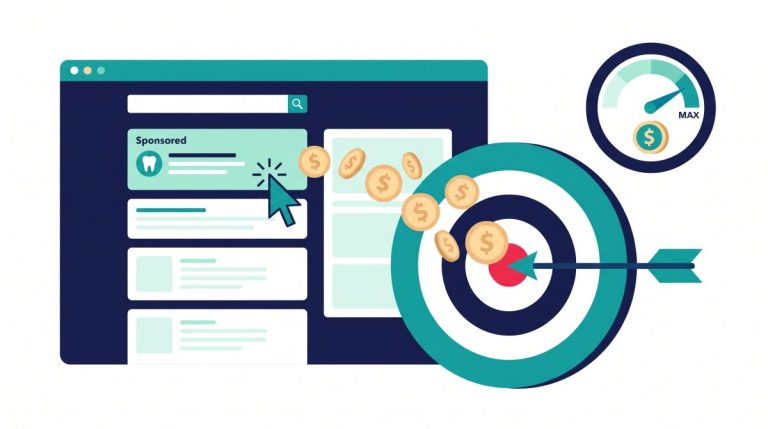
A standard Google Ads search campaign charges per click. Someone types “emergency dentist in Edison,” clicks, and you pay — whether they booked, called, or bounced. You control that through keywords, Quality Score, and pruning search terms, covered in our PPC for dentists guide.
LSA bills on leads. Google’s documentation is blunt: you are charged for each valid lead received through your ad, with prices varying by location, job type, lead type, and bidding mode. Two structural differences matter more than the headline.
It’s keywordless. There’s no keyword targeting. Your campaign is defined by the service categories, areas, and service types you select, and Google decides which searches you’re a fit for. You aren’t buying the term “emergency dentist” — you’re entering an auction for local dental intent as a category.
The auction runs on different inputs. Google’s ad rankings documentation lists your bid, how likely your ad is to result in a lead, what the customer searched for, how relevant your business is, and profile quality — rating, review count, average response time, image quality, and completed verification checks.
Notice what’s absent: keyword match quality, ad copy resonance, landing page experience. In standard Google Ads those dominate cost per click. Here, responsiveness and review profile do the heavy lifting.
What counts as a “valid lead” — and where dentists get hurt
Pay-per-lead only protects you if Google’s definition is stricter than “someone touched your phone number.” Mostly it is, with some sharp edges.
A lead is valid if you answer and speak with the customer, if you miss the call during business hours and the customer stays on the line more than 20 seconds, if you receive a text or email, or if you receive a voicemail. Spam and duplicates get filtered automatically.
The 20-second rule is where practices lose money. If calls go into a phone menu, the timer only starts once the caller presses a key to be routed. Hang up before pressing anything and you aren’t charged. Press one, hold 21 seconds, and you are — even if nobody picked up.
Google also assesses lead quality over 30 days and auto-credits leads later judged poor or invalid. Here’s the catch: lead credits aren’t available for health care verticals, and for health care accounts in the United States, call recordings aren’t available either. Google reassesses in the background, but the credit mechanism you’d rely on to claw back a dud call doesn’t apply to you.
Booking leads aren’t available for health care verticals either. That rules out the scheduling path that makes LSA attractive for trades — a customer books a slot through the ad without a phone call. For a dentist, every lead still routes to your phone or inbox.
The screening process is the real barrier
This is where practice owners underestimate LSA. It’s not self-serve. Before your ad runs, you pass Google’s screening and verification process, and for dentists that’s demanding. From Google’s published US requirements for the Dentist category:
- Background checks: provider check and practice check
- Business registration: business check (select users only)
- Insurance: general liability for the practice, professional liability or malpractice for the provider (select users only)
- Licences: practice licence and provider licence, state level
- Other: National Provider Identifier (NPI) verification (select users only)
The starred items are per-user, not universal — some applicants get pulled into insurance and NPI verification, others don’t, and you won’t know which until you’re in the dashboard. NPI verification links your provider to a national registry and is a common sticking point for multi-provider practices. You also need a public, verified Google Business Profile connected to your Local Services account. Start screening immediately on account creation: it takes an average of three to four weeks after you submit documents.
There’s a risk-based layer too. In the US, Google evaluates your business at signup; some advertisers qualify for accelerated verification and earn the badge quickly, then have 14 days to complete additional verification to keep the ad running. Failing a requested review can mean losing the badge, a pause on your ads, or suspension.
Where LSA ads appear, and when it beats search ads
LSA shows in the Local Services unit at the top of Search results and on Google Maps, for searches in the areas you’ve chosen. Customers can click to call, send a message request, or — where available — book directly through the ad. Message leads are typically priced lower than phone leads, because Google’s pricing reflects the customer’s estimated likelihood to book. And if multiple locations serve the same geographic area, only the highest-ranking ad shows for a query — two offices competing for the same territory cannibalise each other.
LSA wins when your intake process can absorb lead volume on the phone. You need someone answering calls, because that’s where leads land and there’s no booking path to offload them. A live receptionist makes LSA work; a ringing voicemail burns budget.
LSA wins when reviews, response speed, and margin are already good. Profile quality — rating, review count, average response time, image quality, verification checks — is a ranking input and affects what you pay per lead. A strong Business Profile gets amplified; a neglected one gets exposed. Lead cost is also set by local competition for the same categories, so in a dense market your downstream margin has to absorb it.
Search ads win when you need control over intent, messaging, and landing pages. If you want to say something specific about implants, run a dedicated campaign with its own landing page and measure which keyword produced which booked appointment — standard Google Ads gives you that and LSA doesn’t. Search ads also reach research-stage searches a keywordless local campaign won’t touch. See our guide to Google Ads for doctors for that side of the account.
Search ads win when your phone answer rate is the problem. You pay per click, but you don’t pay per lead that arrives while the phone rings out. Fix call handling first.
Neither beats local SEO. LSA buys a position in an auction; it doesn’t build the organic map pack, review velocity, or the website that converts referred patients. Our 2026 local SEO playbook for dentists covers that foundation.
Before you commit, three questions. Can you answer calls during business hours? If not, fix that first — LSA charges you for unanswered calls under the 20-second rule, and dentists get no lead credits to recover bad leads. Is your Google Business Profile verified, connected, and actively reviewed? It’s a screening requirement, and review volume plus response speed are ranking inputs. Is your unit economics strong enough for a local auction? If one new patient doesn’t comfortably cover several leads, paid local services ads won’t rescue a weak practice model.
Mostly yes? LSA fits well: you pay for leads rather than clicks, you get a verified badge that answers a patient’s anxiety, and your existing reputation does the persuading. Mostly no? The fix isn’t a better ad account — it’s reviews, response speed, and local visibility.
The 2026 change every practice owner needs to know
Google is migrating Local Services Ads into Google Ads as a specialised Performance Max campaign type with pay-per-lead goals. Migration began August 2026 for select US home and storefront advertisers, expands to broader groups including service-area businesses in late 2026, and continues into 2027 for non-US accounts and remaining categories.
What doesn’t change: you still pay only for valid leads rather than clicks, ads still show exclusively on Search and Maps in the same positions, and the campaign remains keywordless. What changes:
- The dashboard moves. Budgets, targeting, lead inbox, and photos move into Google Ads, and previous performance reports don’t carry over. Google provides a redirection page for downloading them, so take screenshots before your migration date.
- Weekly budgets convert to daily. Your average weekly budget is divided by seven, and your monthly cap becomes that daily average multiplied by 30.4. Monthly spend doesn’t change, but daily spend can spike on high-demand days.
- Manual bidding is deprecated. You can no longer set a maximum cost per lead. Vertical-level Target CPA is also deprecated, replaced by one campaign-level Target CPA — separate bidding rules for service lines now require separate campaigns.
- Verification carries over. Your business verification status and Google Verified badge transfer automatically, and insurance and licence reverification isn’t required again.
- Business name and address sync one way, managed in your Google Business Profile and synced to Google Ads, where they can’t be edited. A material change triggers a verification review, typically 24 to 48 hours, during which your campaign may temporarily pause.
- BBB callouts are gone. Google recommends populating at least six other structured callouts — business hours, specialties, accepted payment methods.
Google’s notice goes to the account administrator 14 days before migration and again seven days later, so make sure the right person watches that inbox. And allow up to two weeks for performance to ramp back to stable levels — don’t judge the new setup by the first few days of data.
Want a second set of eyes on whether Local Services Ads is right for your practice? Talk to us about your dental marketing and we’ll walk through your numbers before anyone spends another dollar.
Ready to grow your practice?
Book a Free Strategy Call