“Dental marketing” is a broad phrase, but what actually happens for a practice today is narrower and more digital than it was even a few years ago: a patient finds you in a map or an AI assistant, clicks your site, and either books online or doesn’t. Most of the marketing that used to fill that gap — print, referral cards, sign-wrapped cars — now just routes people back into the same digital journey.
This article is about that modern digital patient journey and the three places it can be won or lost: local visibility, how you show up in AI answer engines, and whether your online booking actually works. It is written for owners and managers who need strategy, not tactics for their own sake.
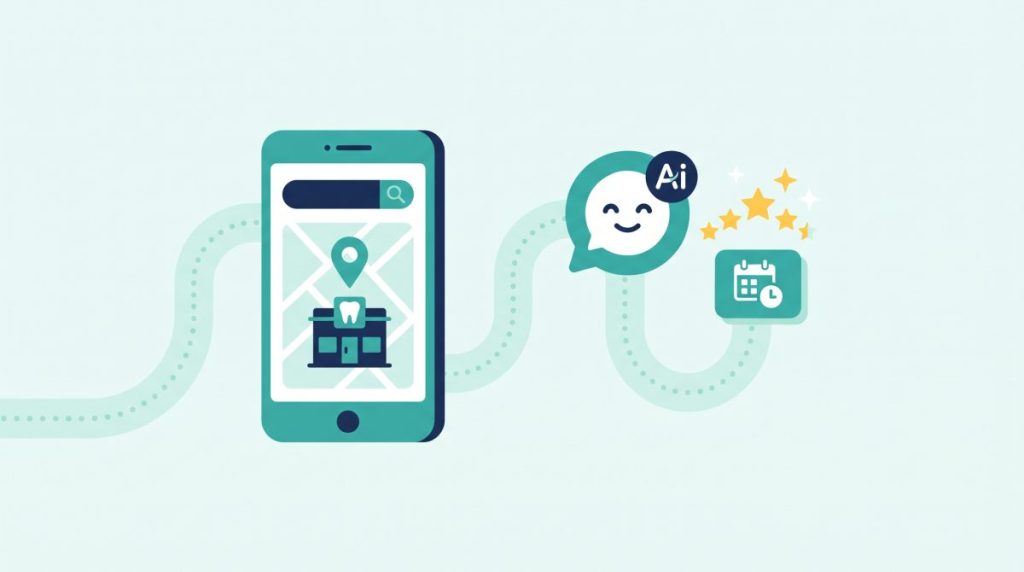
The digital patient journey, end to end
A typical new-patient path today looks something like this: someone searches on their phone, often for a treatment rather than a practice (“implants cost,” “does dental whitening hurt,” “emergency dentist near me”). They see a map result and a few ads. They click, look for reviews, look for reassurance about the practice, and look for a way to book that takes under a minute. If any step breaks, they try the next practice.
Three things decide whether that journey completes: whether you’re visible in the local results, whether your online presence answers their question credibly (including when an AI summarizes it for them), and whether the booking step is frictionless. For practices serving Spanish-speaking patients, that includes answering in their language; see Spanish-language dental marketing.
1. Local visibility — being findable nearby
The majority of dental searches carry local intent. This is the most important, most competitive layer, and the mechanics are covered in depth on our local SEO for medical page, so we will not repeat them here. The strategic point is narrower: local search is no longer only a blue-link map pack. It now also feeds voice assistants, AI overviews, and the answer summaries that appear above the traditional results.
Practically, that means your Google Business Profile and consistent local information (name, address, phone, hours, services, photos) are the raw material for multiple discovery surfaces at once — search, maps, voice, and AI. Keeping that data accurate and current is still the highest-leverage, lowest-effort local work available.
Reviews are the other half of local trust and are covered separately in how to get more Google reviews for your dental practice.
2. AI answer engines — the new front door
This is the shift that has changed dental marketing strategy most in the last two years, and it is worth understanding even though the tooling is still maturing.
When a patient asks an AI assistant or sees an AI-generated summary in search, the answer is assembled from sources the system trusts — often a practice’s own clear, structured, credible content. The practical consequences for a practice:
Be findable by the systems that read the web. The basics still apply: crawlable pages, accurate business details, genuine reviews, structured data. There is no separate “AI file” required, and Google’s AI optimization guidance is explicit that useful content and normal SEO remain the foundation — AI optimization is not a shortcut or a separate ranking trick.
Answer the actual questions patients ask, clearly. A page that plainly explains “how long does a root canal take” or “what does an implant consultation involve,” in clear, direct language, gives any answering system a more accurate basis than a page of marketing slogans. That is practical advice from how these answers tend to be assembled, not a rule stated in Google’s guidance, which notably says there is no single ideal page length to aim for. This favors the small, genuinely helpful, question-answering pages we recommend on our content marketing work.
Be accurate and current, because errors propagate. If your hours or services are wrong, an AI may repeat them. This is another argument for accurate business listings and current content.
Don’t chase AI placements. No legitimate agency can guarantee that an AI assistant will cite you or recommend you. Anyone promising AI placements is selling something that isn’t a guaranteed product. Our own advice to practices is simple: treat AI visibility as a by-product of doing the fundamentals well, never as a line item you can buy or optimise for directly. Google’s AI optimization guidance is consistent with that posture — it prescribes no separate AI file, schema or task to implement, and it makes no promise about citations in AI answers.
3. The online booking journey — where good intent goes to die
Plenty of practices get the click and lose the patient afterward. The booking experience is the last and most decisive step, and small friction here is expensive.
What a frictionless dental booking journey looks like:
Find the book button fast. It should be obvious on every page, especially on mobile. A patient should not have to hunt for it.
Minimal friction. Fewer fields, fewer steps, fewer reasons to abandon. Every extra tap or required field loses some people. Ask only for what you genuinely need to schedule.
Mobile-first. Most dental searches happen on a phone. If booking is clunky on a phone, it is effectively broken.
Clear confirmation and next step. Tell them exactly what happens next and how they’ll be reminded. That reduces the “did it go through?” drop-off.
Service-specific paths. A patient looking for Invisalign and one looking for a cleaning need different first appointments. Routing them to the right book reduces no-shows and confusion.
If your site is slow, cluttered, or hard to navigate, no amount of traffic will fix it — start with the basics in why a dental website drives patients away and our website development for healthcare page.
Paid search within the digital journey
Organic and paid are complements, not substitutes. Paid search — Google Ads — is covered on our Google Ads for doctors page and in our guide to maximizing PPC spend. The strategic point here: paid search buys you a place in the moment of high intent, but AI answers and local results are increasingly what fill that moment for a growing share of searches. A balanced program accounts for both.
Email, SMS, and social in the digital mix
Digital marketing is not only search. The retention and follow-up layer — email and SMS — converts the patients you already attract, and social builds the trust that makes people choose you over the practice down the road. Our social media marketing and reputation management pages cover those channels; dental email and text marketing is where the retention follow-up is discussed in full.
How to prioritize
If you are building or fixing a digital program, a sensible order is:
- Get your business information accurate everywhere (Business Profile, listings, hours, services). Cheapest, highest foundation.
- Make sure reviews flow steadily. Trust compounds.
- Make the website fast, clear, and bookable on a phone.
- Publish genuinely useful, question-answering content for the treatments you actually want more of.
- Add paid search for the highest-value treatments where organic takes time.
- Add email/text follow-up to convert and retain.
Notice that AI answer visibility isn’t a separate line item — it falls out of doing 1–4 well. That is genuinely the case, and it is good news, because those are the steps that also help in ordinary search.
Where this all fits
Digital dental marketing is one program, not a pile of channels. Our dental marketing page describes how we tie local SEO, paid search, social, reputation, website and content into one plan for a practice, and private practice marketing covers the broader practice-management angle.
If you want an outside read on where your digital journey is actually leaking — traffic you’re getting but not converting, or visibility you’re missing — tell us what’s happening and we’ll diagnose the specific break rather than pitch a package.
Ready to grow your practice?
Book a Free Strategy Call