Ask a practice owner what their biggest marketing leak is, and you will usually hear “not enough new patients.” Ask how many people expressed interest but never booked, and the room usually goes quiet.
The gap between “I’m interested” and “I’m booked” is where email and text messaging earn their keep. These are two channels a practice controls directly — no auction, no algorithm, no ad spend. A patient who leaves your office or submits a form is reachable without paying for the click, and in our view practices routinely leave that contact on the table.
There is also a compliance dimension that dental marketing content tends to skip. Texting a patient’s phone is regulated activity, not just marketing. This guide covers both the practical sequences and the legal guardrails.
Why email and SMS work for dental practices
Most dental searches happen with local intent, but the decision is not made in the search results. Someone finds you, checks a few things, and either calls or doesn’t. The research window — reading your reviews, glancing at your site, asking a question — often spans days or weeks.
That gap is exactly what email and text are built for. Search brings the person in; email and SMS give you a way to bring them back. Practices that set up a follow-up system and practices that don’t tend to end up with the same inquiries and very different booked-patient counts — how big that difference runs depends on your list, your follow-up speed, and how many people actually respond. We cannot promise you a number here, and we won’t invent one.
Email and text also compound. A patient who receives a genuine, useful message after a visit is more likely to book their next cleaning, refer a friend, or leave a review — outcomes that compound over years rather than producing a single tracked conversion.
Where the leads actually come from
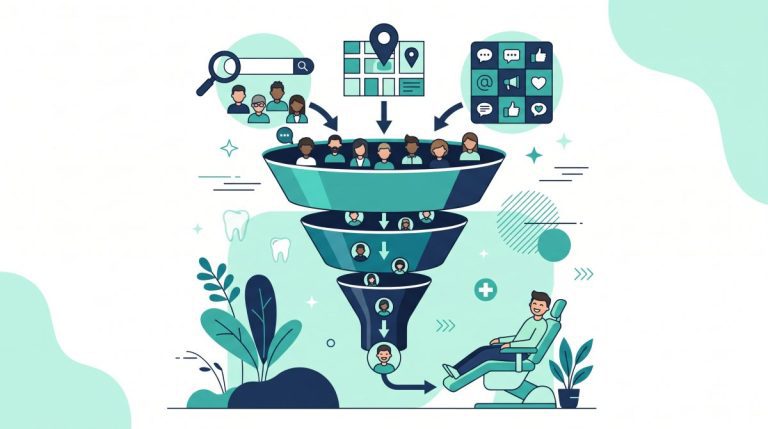
Before building sequences, map your sources. In our experience, dental leads arrive through a handful of channels:
Website contact and booking forms. Someone asked to be contacted. That is about as high-intent an audience as you will encounter. In our view, a practice that stops at a single “thanks for reaching out” and never follows up again leaves some of its most ready prospects waiting, and that gap is often the biggest win available.
Missed calls. Calls go unanswered during busy hours or when the front desk is with a patient. That is common enough that practices planning for it are not unusual — and the caller who did not reach you has already told you what they want. Our view is that a fast text-back to a missed caller is among the more dependable follow-up triggers you have, because the intent is already explicit and the conversation is short. If you do not have call tracking or missed-call automation in place, setting it up first is worth considering. Our guide to getting more patients covers the broader patient acquisition picture, including how Google Ads campaigns measure phone calls and form submissions back to the keyword that produced them.
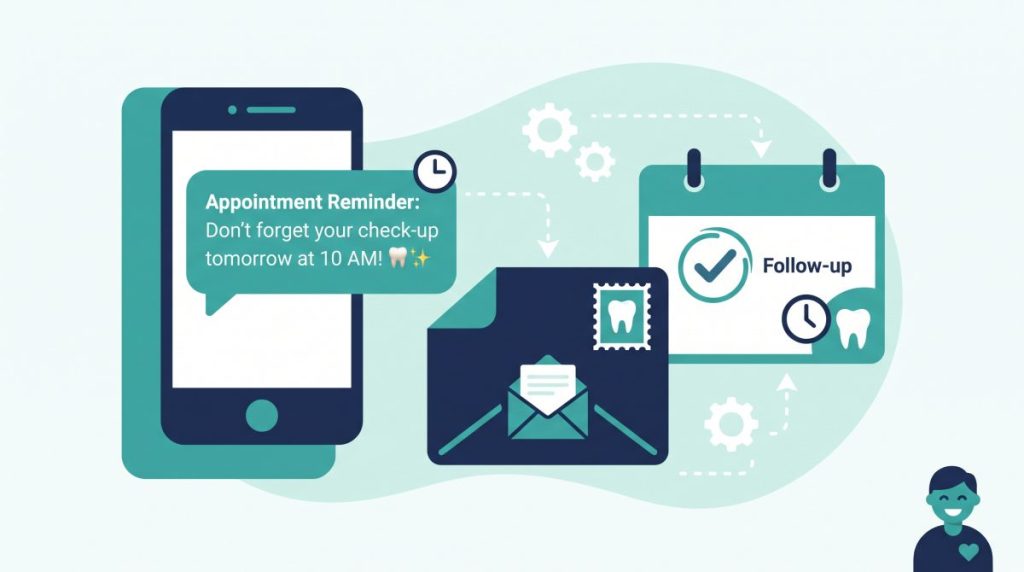
No-shows. Every empty slot is lost revenue. Our view is that a simple confirmation and reminder sequence is one of the highest-return automations a practice can switch on.
Inactive patient list. Patients who have not been seen in 12, 18 or 24 months. This is a warm, permissioned audience, and in our view most practices leave it largely untouched.
The sequences worth building first
The web form follow-up
Someone submitted your contact form or booking form. Within a minute or two, an automated confirmation. Within a day, a short human-sounding message offering to answer questions or confirm a time. Our view is that this sequence does more work for a practice than a general email program does, because the intent is already there.
The missed-call text-back
If a caller didn’t reach you, a short, friendly text within a minute: “Sorry we missed you — this is [practice]. Is now a good time to help with your question?” The caller already wanted to reach you, which is why we rank it high on the list of single messages worth automating.
The no-show prevention
Confirmation at booking, a reminder 48 hours before, a confirmation again a few hours before, and a rebooking link if they need to cancel. This recovers slots you already earned.
The new-patient nurture
After a first visit, a short sequence that handles the most common next-step questions: when to come back, how to care for what was done, and what preventive care looks like. Keep it to two or three messages, spaced out.
The inactive patient reactivation
Patients last seen 18–24 months ago, filtered to those with no outstanding treatment. A simple, respectful check-in. Do not lead with an offer; lead with a question. Message fatigue and over-messaging are real risks in dental texting — more is not better.
The compliance side — this is not optional
Dental marketing that uses text messaging in the United States is subject to real regulation, and the penalties for getting it wrong can be significant. Your phone number provider can also block numbers that generate complaints.
HIPAA
HIPAA governs what you may send and on what device. A text message is rarely an appropriate channel for anything clinical. Protected health information — treatment details, lab results, imaging, anything about a diagnosis — should not be sent by ordinary SMS unless a Business Associate Agreement is in place with your messaging vendor and the system is configured to handle it. The HHS describes a BAA as a contract or other written arrangement in which the vendor gives satisfactory assurances that it will appropriately safeguard protected health information. In our view, most practices should keep SMS to logistics: appointment reminders, confirmations, directions, rebooking. Keep it that way unless you have specifically addressed the compliance architecture with a compliance professional and your attorney.
TCPA and consent
The Telephone Consumer Protection Act and its state-level cousins require prior express written consent before marketing texts go to a mobile number. There are narrow exceptions, and they are narrower than practices often assume. The FCC’s current consumer guidance is explicit: texts sent to a mobile phone using an autodialer are banned unless the phone owner previously consented, commercial texts require written consent, and a recipient may opt out of any robocall or robotext at any time and in any reasonable manner.
Practically: get explicit consent at the point the phone number is captured — at booking, at check-in, on a form — with language that specifically covers text messaging, and record when and how it was given. Do not buy a list and blast it. A patient who opted in for appointment reminders has not necessarily opted in for marketing.
Practical safeguards
Keep a record of consent per contact. Honor STOP keywords (STOP, UNSUBSCRIBE, QUIT, and the common variants) and process opt-outs immediately. Send during reasonable hours — generally not before 8am or after 9pm local time. Message frequency matters: patients who find texting annoying will leave, and they may leave publicly.
If you are unsure where your specific situation lands, this is a question for a healthcare attorney, not for a marketing blog — including this one. We are describing practice patterns, not legal advice.
Email for dentists: what to actually send
Email is slower than text and less urgent, which makes it better for education and reasoning.
The categories that consistently earn their place: preventive care reminders and recency; new-patient education about a service you provide; insurance and payment basics; seasonal content (whitening in spring, school dental checks in late summer); and re-engagement for lapsed patients. Beyond that, dental email tends to become noise.
Our view is that frequency beats length here: a short, genuinely useful message once a month will do more for you than a long newsletter that arrives when the practice has nothing to say. Never send clinical detail over email outside a secure patient portal; email is not a secure channel for protected health information.
Keep consent and unsubscribe handling clean here as well — CAN-SPAM applies to email marketing in the US, and the practical requirements (honest sender identification, working unsubscribe, honoring opt-outs) are straightforward.
How email and text fit with the rest of your marketing
Email and SMS are strongest as the follow-up layer that converts the attention other channels generate. Local search brings high-intent local patients — our local SEO for medical and Google Maps SEO pages cover how patients find you. Paid search brings people already ready to act — see Google Ads for doctors, which also covers conversion tracking for calls and forms. Whatever wins the click, email and SMS are how you actually convert it and keep the patient coming back.
Our social media marketing page covers the awareness layer, and reputation management covers turning happy patients into public proof that feeds every channel.
What to measure
Track outcomes, not activity. Open and click rates are secondary; the numbers that matter are booked appointments from email/text, reactivated inactive patients, recovered no-shows, and missed-call conversions. Google Search Console is not the place to look for those — its Performance report covers clicks, impressions, click-through rate and average position for results in Google Search, so it tells you how the site is performing in organic search, not how many appointments a text message produced.
The numbers you want come from the systems that actually handle the appointment: your booking system’s source tracking, your practice management system’s appointment and reactivation reports, your phone call tracking for missed-call and answered-call outcomes, and the reporting inside your email and SMS platform. Agree on how a lead is attributed to a channel before you start, or the totals will not reconcile.
If you want help mapping which of these gaps is costing your practice the most — missed calls, unresponsive web leads, or a neglected inactive list — get in touch and we’ll walk through where the leakage actually is before you spend a dollar.
Ready to grow your practice?
Book a Free Strategy Call