
Why Local SEO Is the Single Biggest Growth Lever for Dental Practices in 2026
If you’re a dentist and you’re not investing in local SEO, you’re leaving money on the table — every single day. Here’s the reality: 76% of people who search for a “dentist near me” on their phone visit one within 24 hours. And the top three results in Google’s local pack capture the vast majority of those clicks.
A strong dental marketing company strategy starts with local SEO because that’s where your highest-intent patients are searching. Someone actively looking for an emergency dentist, a pediatric dentist, or a dentist accepting new patients is ready to book. If you’re not visible at that moment, your competitor is.
This playbook covers everything you need to dominate local search in 2026.
1. Google Business Profile Optimization: Your Digital storefront
Your Google Business Profile (GBP) is the most important piece of real estate in local SEO. It’s the panel that appears on the right side of search results when someone looks for a dentist in your area. Getting it right is non-negotiable.
Complete Every Single Field
Google rewards fully completed profiles. Fill out every field possible: business name (exact match to your signage), address, phone number, website, hours, services, and attributes. Don’t leave anything blank.
Choose the Right Primary Category
Select the most specific category that describes your practice. “Dentist” is fine, but if you’re a pediatric dentist or an endodontist, use that. Google allows one primary category — choose carefully as it significantly impacts which searches you appear for.
Add All Your Services
List every service you offer. This helps you appear for a broader range of search queries. Common dental services to list: teeth cleaning, dental implants, teeth whitening, braces, root canals, emergency dental care, cosmetic dentistry, pediatric dentistry, and more.
Post Regularly to Google Business Profile
GBP has a posts feature — use it. Share updates about your practice, new services, team highlights, special offers, and educational content. Posts expire after 7 days, so consistency matters. Active posting signals to Google that your business is engaged and current.
Add High-Quality Photos
Practices with photos receive significantly more clicks and direction requests. Add photos of: your exterior (so patients can find you), your interior, your team, before-and-after cases (with patient permission), and your reception area. Update them regularly — stale photos hurt perceived credibility.
2. NAP Consistency: The Foundation of Local SEO
NAP stands for Name, Address, and Phone number. And the single most critical rule is this: it must be identical everywhere it appears online.
Why Consistency Matters
Google cross-references your NAP across dozens of data sources — directories, review sites, social media profiles, and other websites that mention your practice. Inconsistencies confuse search engines and dilute your local ranking signal. If Google sees “Smith Dental” on one site and “Smith Dental Practice” on another and “Dr. John Smith, DDS” on a third, it can’t confidently establish that all three refer to the same business.
Where to Audit and Update Your NAP
- Your own website (header, footer, contact page, schema markup)
- Google Business Profile
- Bing Places
- Apple Maps
- Yelp
- Healthgrades
- Zocdoc
- Dentalez or similar dental-specific directories
- Local chamber of commerce and business association listings
- Any other directory your practice appears in
How to Find Inconsistencies
Use a citation audit tool or have your dental marketing company run a full NAP audit across 50+ data aggregators. Minor variations — like “St” vs “Street” or “Dr” vs “Doctor” — can still cause problems. Aim for pixel-perfect consistency.
3. Local Keyword Targeting: Getting Found by the Right Patients
Keyword research for local dental SEO is different from general SEO. You need to target keywords that have local intent — meaning people searching are looking for a dentist in a specific geographic area.
Primary Local Keyword Patterns
- [City] dentist
- Emergency dentist in [neighborhood/city]
- Dentist near me
- [City] cosmetic dentistry
- Pediatric dentist [city]
- Dentist accepting new patients [city]
- Affordable dentist [city]
- Same-day dentist [city]
Long-Tail Local Keywords
Longer, more specific queries often convert better because intent is clearer. Examples: “root canal specialist in downtown [city]”, “teeth whitening dentist near [neighborhood]”, “family dentist open Saturday in [city]”. These are goldmines for specialized services.
Where to Use Local Keywords
- Title tags and meta descriptions (with city/neighborhood)
- H1 headings on service pages
- Body content on location and service pages
- Image alt text
- Google Business Profile description (180 characters — use them wisely)
- Schema markup (LocalBusiness schema)
- Blog content targeting location-specific dental questions
4. Review Generation Strategies: Your Most Powerful Local SEO Asset
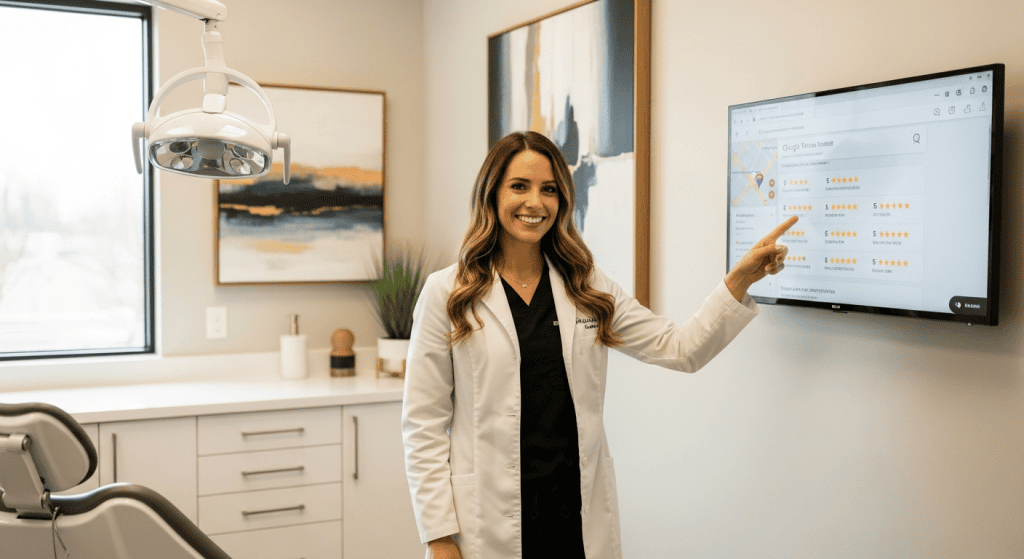
Reviews are not just social proof — they are a direct local ranking factor. Google has confirmed that review quantity, velocity, and sentiment all influence local pack rankings.
Make Reviewing Easy for Patients
The harder you make it to leave a review, the fewer reviews you’ll get. Send patients a direct link to your Google review page via SMS or email immediately after their appointment. Short, personalized messages with a direct link dramatically increase conversion rates.
Respond to Every Review — Positive and Negative
Responding to reviews signals engagement. Thank patients who leave positive reviews by name. For negative reviews, respond professionally, empathetically, and offline (ask them to call the office). Never ignore a negative review — it signals to future patients how you handle problems.
Use Review Generation Software
Tools like Podium, BirdEye, or Reputation.com automate review request campaigns. After appointments, these platforms send automated SMS or email requests with direct links. This can 3x or 4x your review volume compared to passive solicitation.
Target Google Reviews Specifically
While all reviews matter, Google reviews carry the most SEO weight because they’re directly visible in search results. Prioritize getting patients to review you on Google over other platforms.
5. Citation Building: Building Your Local Authority
Citation building is the process of getting your business name, address, and phone number listed on relevant, authoritative websites and directories across the internet.
Primary Citation Sources for Dentists
Focus your efforts on the high-authority, most-used platforms first:
- Google Business Profile (done first, above)
- Bing Places
- Apple Maps
- Yelp
- Healthgrades
- Zocdoc
- Care.com (for family dentists)
- Yellow Pages
- BBB (Better Business Bureau)
Dental-Specific Directories
Many industries have niche directories that carry significant authority in local search. For dentistry, key ones include: Dentalez Network,Dentalplans.com, 1-800-Dentist, ADental, and AAID (for implant specialists).
Quality Over Quantity
Ten listings on high-authority, relevant sites beats 100 listings on spammy, irrelevant directories. In fact, irrelevant or low-quality citations can actually hurt your local SEO. Focus on directories where your potential patients are actually looking.
6. Local Link Building: Earning Authority From Other Local Websites
Backlinks — links from other websites to yours — remain one of Google’s most important ranking signals. For local SEO, you want backlinks from locally relevant and thematically relevant sources.
Local Link Building Strategies That Work
- Local sponsorships: Sponsor a local youth sports team, charity event, or community organization. Most will link back to your site from their sponsor page.
- Guest blogging: Write valuable dental health content for local news websites, neighborhood blogs, or community publications.
- Local partnerships: Develop relationships with local businesses that don’t compete with you (orthodontists who refer to oral surgeons, for example). Ask for a link from their “resources” or “partners” page.
- Scholarships: Offer a local scholarship through a university or high school in exchange for a link on their website.
- Press coverage: Get involved in a local news story or press release about a community event, new technology, or charitable work your practice is doing.
Measuring Local SEO Success: What to Track
If you’re not measuring, you’re not marketing. Track these key metrics monthly:
- Google Business Profile views and direction requests
- Website traffic from local searches (via Google Analytics)
- Google local pack rankings for your target keywords
- Number of new reviews (volume and velocity)
- Average star rating
- Citation count and consistency score
- Organic traffic growth over time
- Phone calls and appointment requests attributed to local search
Final Thoughts: Local SEO Is a Long Game Worth Playing
Local SEO for dental practices isn’t a quick fix — it’s a long-term investment that compounds. A strong local SEO foundation built on GBP optimization, NAP consistency, local keyword targeting, review generation, citations, and link building will pay dividends for years.
Working with a dental marketing company that understands local SEO specifically for healthcare is the fastest path to results. But the basics above — done consistently — will put any dental practice ahead of the majority of their competition in local search.
Your next patient is searching right now. Make sure they find you first.
📍 Serving New Jersey Dental Practices
We work with dental practices across NJ with city-specific strategies backed by real local market data. See your city:
→ Dentist Marketing Edison, NJ
→ Dentist Marketing Jersey City, NJ
→ Dentist Marketing Woodbridge, NJ
→ Dentist Marketing Trenton, NJ